HEADLINE NEWS
New York Extends Trial of Open-Loop Fare Payment

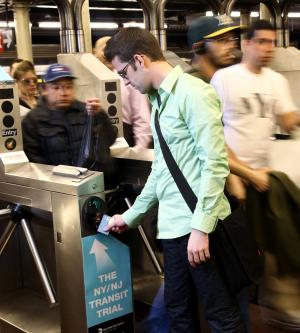
New York City-area commuters will be able to tap a variety of contactless credit and debit cards or other devices to pay directly at train gates and onboard buses as part of a much-anticipated extension of a trial of open-loop fare collection.
The new six-month trial, which begins today, will enable riders to directly pay fares on buses and at gates to commuter trains in and around New York City and neighboring sections of New Jersey, in addition to gates of a subway line in the city. It also expands the fare collection to cards or applications on devices from multiple financial institutions and at least one more payment brand. The original trial, launched in mid-2006 on one line of the New York City subway, involved only MasterCard Worldwide and Citigroup.
UPDATED: Contactless payment from the additional card network, Visa Inc. and it's payWave application, will not be accepted in the trial until after July 31. MasterCard, which is co-organizing the project, will enjoy a two-month exclusivity period, during which only cards or devices carrying its PayPass application will be accepted for fares. The trial is scheduled to run through Nov. 30. The PayPass cards or applications for the new trial could be issued by a number of banks, not just Citi.

The new trial also moves the giant Metropolitan Transportation Authority, or MTA, a little further down the road toward meeting one of its goals–that of offering open-loop payment of transit fares. This would help the agency rid itself of its out-of-date magnetic-stripe MetroCard, which it now uses to collect fares among the 7.5 million riders it serves daily on buses and the subway.
In addition, the expanded trial will test a regional fare-collection system, involving transit ticketing not only from the MTA but the Port Authority of New York and New Jersey and NJ Transit, using the same bank cards or devices. At present, customers need to use different fare cards or tickets to ride across the region. The MTA and other transit agencies, of course, could also issue closed-loop contactless cards that are interoperable.
MasterCard’s system to quickly authorize transit fare transactions from bank cards while keeping risk at acceptable levels is likely being used for the new trial as it was for the original pilot with Citigroup that launched in July 2006.
But unlike the original trial, plans for the new trial, sometimes referred to as “phase II” of the project, call for real-time authorization of fare-payment transactions.
The new trial, or phase II, will also enable two of the participating transit agencies, MTA and NJ Transit, to support flexible-fare policy when customers pay with their bank cards or devices. That includes offering daily, weekly, biweekly and monthly passes, as well as discounted fares for senior citizens, disabled riders and students, according to today’s announcement.
UPDATED: "Customers who participate in the pilot will receive exactly the same discounts and fare options as those who pay via MetroCard,” an MTA spokesman told NFC Times.
But supporting the flexible-fare policy might be one reason phase II is behind schedule. Organizers had planned to launch it last year.
As with the first trial, riders on trains or buses run by all three agencies can also choose to prepay or “prefund” an amount in their credit or debit accounts used to pay transit fares. They will receive a discount of 15% for prepaying, similar to the reported 20% discount customers received for prepayment in the first trial. Or the riders can choose a flat-rate “pay-as-you go” option.
In each case, the fares show up on the customers' credit or debit statements from their financial institutions.
In the original trial, customers of Citigroup could tap their PayPass cards, key fobs, and later their NFC phones, directly at 80 fare gates in 30 metro stations along the Lexington Avenue subway line, one of New York City’s busiest. The customers could use the same cards, fobs and phones to pay for purchases at contactless terminals at McDonald’s restaurants, 7-Eleven stores and other retail points of sale.
UPDATED: The MTA turned off the PayPass readers from the first trial a year ago and have more recently replaced them with new terminals for the new trial phase, a MasterCard spokeswoman told NFC Times.
The six-month NFC portion of the first trial began in January 2007, with a select group of consumers issued Nokia 6131 NFC phones carrying a PayPass application stored in an embedded secure chip in the phones.
There was no mention of NFC in today’s announcement of the trial extension, although it is possible one or more of the issuers will launch an NFC pilot in connection with the expanded trial. Besides cards, consumers might use other contactless form factors, such as passive contactless stickers or perhaps microSD cards carrying credit or debit applications.
In addition to New York, transit authorities in London, Chicago, Philadelphia, Washington, D.C. and Paris, among others, are seeking to enable open-loop collection of transit fares.