HEADLINE NEWS
Contactless Loyalty Scheme Gets Boost From Deal with Acquirer

A deal between loyalty-scheme operator Zapa Technology and Ireland’s largest merchant acquirer, AIB Merchant Services, could see Zapa’s contactless stickers rolled out more widely in Ireland and also gain a foothold in the United Kingdom.
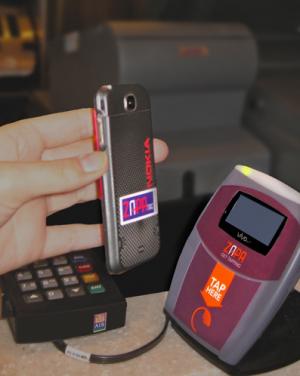
AIB Merchant Services, which is a joint venture between one of Ireland’s largest banks, Allied Irish Banks, and processor First Data Corp., owns nearly half of the merchant acquiring business in Ireland in terms of retail outlets. The joint venture is offering merchants its “loyaltyplus” service, which uses Zapa’s loyalty platform and its passive contactless stickers to enable consumers to tap their mobile phones or other devices to earn and redeem points for discounts and other incentives.
Update: Zapa, however, in late October reportedly appointed a provisional liquidator to help it pay off its debts. End update.

"The cost is very low, allowing small merchants who obviously don’t have a large amount of cash to work with to operate a loyal program," Sharon Duffy, marketing manager for AIB Merchant Services, told NFC Times.
The joint venture has signed up retailers with a total of 120 to 150 outlets since June, including a small chain in the UK, which Duffy declined to name.
She said merchants will pay up to a flat 30€ (US$38.65) per month to offer the service to their customers, though that fee could be as little as 15€ per month under a special offer that ends this month. AIB Merchant Services and Zapa would split the fee.
The merchants might also pay a little extra rental charge for their point-of-sale terminals, especially if they don’t have newer terminals that can accept contactless readers.
About 90,000 merchant locations accept conventional payment cards nationwide, according to the Irish Payment Services Organization. That would give AIB Merchant Services, which has a market share of about 48%, more than 40,000 merchant locations.
Zapa Technology, launched last year by John Nagle, the former head of Ireland-based electronic top-up and payments company Payzone, has 675 merchant locations in Ireland, with about 130,000 "active" stickers or Zapatags distributed to consumers, Donal McGuinness, Zapa’s chief operating officer, told NFC Times.
He defines active tags as those used at least once. All told, Zapa has recorded more than 1.5 million transactions to date, with transactions running about 100,000 per month, he said. The 675 merchant locations include those added recently by AIB Merchant Services, as well as small retailers in two towns in Ireland, Dundalk and Tuam, and about 60 outlets of the Insomnia café chain nationwide. Zapa also offers closed-loop prepaid payment with the tags for some of the merchants.
"If we go into larger retailers, they’re always going to want to integrate into their EPOS (electronic point of sale) and do more sophisticated loyalty and product-based loyalty," McGuinness said. "There is a huge number of smaller merchants like dry cleaners or flower shops, which would not be sophisticated from a retail technology point of view, but they always have a POS terminal. The point of this partnership is to allow all those small standalone retailers to have a sophisticated loyalty program at a low cost."
Duffy of AIB Merchant Services said the contactless stickers will cost merchants less than €1 apiece. That’s after they exhaust their initial allotment of stickers that comes with signing up for the service. The more merchants that order the stickers, the lower the price per piece, she said. A Chinese company supplies the tags, using a 1-kilobyte Mifare chip.
Still, Ireland is a small market and AIB Merchant Services controls less than 1% of the acquiring market in the much larger UK. Zapa's plan is to expand throughout Europe, which will be a difficult task. But it appears to have set its sights on the UK next.
"There are also additional significant deals Zapa has with multiple players in its pipeline for UK," Mohammad Khan, president and co-founder of U.S.-based Vivotech, told NFC Times. He declined to name the players. Vivotech supplies the technology behind Zapa's loyalty platform and also sells the contactless readers.
McGuinness said Zapatag users at stores served by AIB Merchant Services pay for purchases with their conventional debit or credit cards and can tap their tags at any point during the payment transaction to earn or redeem points. The tags store an ID number, which is transmitted to the POS terminal. Points are stored on a server.
Zapa also offers separate phone apps for both smartphones and feature phones that enable consumers to check point balances and see a record of points they’ve redeemed. Also, merchants can send customers offers via SMS or e-mail.
"What we’re really trying to do is emulate a pure NFC experience with these stickers, so when the real NFC arrives, we can have a seamless transition."
With the loyalty service, the smaller merchants can track some of their customers’ buying behavior, which is nearly impossible to do for those same merchants that offer discounts or other bonus programs using paper cards, McGuinness noted.
But the AIB Merchant Services-based rollout faces challenges.
Irish banks are not yet rolling out contactless payment cards, so the readers the acquirer installs would only be used for the Zapa scheme, at least for the time being.
And passive stickers offer no direct communication with applications on the handset. Moreover, when consumers replace their phones, they’d likely need new stickers. And if a large merchant or bank wants to issue their own contactless stickers, consumers would be hard-pressed to support more than one tag on the outside of the same phone.
Those problems go away with full NFC phones. But while NFC handsets are on the way, it could be at least a few years before there are enough models available for Zapa to bid farewell to the stickers.
AIB Merchant Services’ Duffy noted the contactless readers the company installs for the Zapa service could also be used by the merchants to accept standard contactless payment cards when banks issue them.