HEADLINE NEWS

Taiwan Chip Company Supplies NFC Technology to Low-Cost Phone Maker

Taiwan-based chip maker MStar Semiconductor announced today it is supplying NFC technology to Russia-based phone maker Fly for one or more handsets for the European market to be released as early as next month.

Austrian Bank Announces Plans to Launch Mobile-Payment Service with microSDs and iPhone

Feb 5 2012 (All day)

Raiffeisen Bank International, one of Austria’s largest banks, is planning to launch contactless-mobile payment with microSD cards and an iPhone attachment.

Samsung Confirms NFC Chip in Galaxy Note, though NFC Version Already Shipping in Korea

Samsung Electronics has confirmed it has an NFC version of its Galaxy Note, though that comes as no surprise to operators in South Korea, which have been selling the tablet-smartphone hybrid with NFC inside for about two months.

Airline Industry Tech Provider Sees Major Role for NFC to Speed Check-in and Boarding

With the help of NFC technology, airline passengers will routinely tap their mobile phones to pass through security checkpoints and boarding gates by 2018, predicts major airline industry IT and communications services provider SITA.

Turkcell Launches ZTE Android NFC Phone as it Continues Mobile-Wallet Rollout

Turkey’s largest operator, Turkcell, has introduced a second branded Android NFC phone model for its mobile wallet and has launched a new toll-collection application for the model.

Inside Secure Releases New Android NFC Stack; Accuses NXP of Monopolizing Market

NFC chip supplier Inside Secure has released a new version of its NFC software stack, as it seeks to break rival NXP Semiconductors’ dominance of the market for NFC chips in Android phones.

Microsoft Requires ‘Visual Mark’ for Windows 8 Devices Supporting NFC

Microsoft is requiring device makers to include a “visual mark” for tablets and PCs supporting NFC and running the software giant’s forthcoming Windows 8 operating system.

Japan’s KDDI Announces Plans for Small NFC Launch with Galaxy S II

Jan 17 2012 (All day)

Japan’s second largest mobile operator, KDDI, said it would launch Japan’s first mobile NFC service late this month with the Samsung Galaxy S II–though the service will start out small because of the lack of phones that support both standard NFC and Japan's proprietary FeliCa technology, as well as Japan's nearly nonexistent infrastructure of standard contactless readers.

Spanish Bank Plans To Turn Barcelona into Contactless-Payment City

Large Spanish retail bank La Caixa will begin rolling out 1 million contactless cards along with more than 15,000 point-of-sale terminals and 500 contactless ATMs in Barcelona this month.

GlobalPlatform and SIMalliance Seek to Build ‘De Facto Standard’ for Accessing Secure Elements

Jan 12 2012 (All day)

The SIMalliance trade group and GlobalPlatform standards organization say they are working on what they predict will become a “de-facto standard” for the way apps on NFC phones communicate with secure elements.

Sony Unveils Pair of Android NFC Phones and ‘SmartTags’

Sony Ericsson has announced two NFC-enabled Android smartphones and NFC tags for its Xperia series, touting NFC as enabling consumers to share content, as well as “an increasing number of NFC applications.”

Visa Announces Certification of Six NFC Phone Models for SIM-based payWave

Jan 11 2012 (All day)

Visa has announced its first certifications of NFC phones, approving six models to run its contactless application, payWave, on SIM cards.

French Telcos to Bill Low-Value Ticket Purchases

Consumers in the French Mediterranean city of Nice this spring will be able to pay for low-value tickets on the city’s bus and tram network directly on their mobile phone bills as part of a planned multiapplication NFC project.

But mobile operators say they are offering the payment service for consumer convenience, not to compete with banks.

“We are only trying to facilitate, as in the past, digital content,” Bruno Prexl, spokesman for French mobile operator group Association Française du Sans Contact Mobile and m-payment marketing manager at Bouygues Telecom. “In the past, it was ringtones and Java games. Now we are downloading low-value tickets. It makes sense to have one- (or two-) click payment through the phone. And today, the only one-click solution is the mobile operators’ bill.”

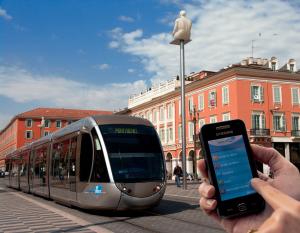
Project organizers are considering allowing consumers to pay for purchases as high as about 10 euros (US$14), NFC Times has learned. That would allow them to buy single tickets or perhaps up to a carnet of 10 tickets. For higher-value transit tickets, such as weekly or monthly passes, consumers would pay through their banks, perhaps by securely entering a PIN code on their handsets with their preregistered bank-account information on file, then downloading the pass over the mobile network to the SIM cards in their phones. They would tap the phones on readers onboard buses and trams in and around Nice to cover fares, just as they would with the low-value tickets.

Consumers in the project will also be able to tap their phones to make retail purchases, using bank-debit applications stored on the SIMs. The Nice launch, expected to begin around April 2010, will involve a number of other applications. French operators and other organizers hope the project will serve as a prelude to a national rollout of NFC services in 2011.

For Veolia Transport, the transit operator participating in the Nice project, enabling customers pay for single tickets or other low-value transactions on their phone bills will save time, said Dominique Descolas, manager, smart ticketing systems. He declined to discuss how much customers might be able to charge on their phone bills, but said higher-value transactions, such as passes, would require them to go through their banks. That might require them to enter account numbers for the first purchase then short codes to renew the pass. Or banks might require the subscribers to fill out paperwork to preregister the accounts, also a hassle for many.

“We’ll see if users accept to have a debit (for small ticket purchases) on the telephone bill, despite the fact it’s not a telecom charge,” he told NFC Times recently. “The most important thing for us is what is the most convenient and acceptable for our clients.”

Austria’s largest mobile operator, mobilkom, began enabling subscribers to buy SMS-based transit tickets with their mobile phones in 1999, and in 2002 formed its own bank. The telco also enables small payments, such as parking fares and snacks from vending machines. Most purchases show up on monthly phone bills. But mobilkom is among the rare telcos that also owns a banking license. Japan’s largest mobile operator, NTT DoCoMo, goes further, having launched its own credit brand, iD, in late 2005 and credit service, DCMX, the following year. Subscribers can charge up to 10,000 yen (US$114) per month and have the amount added to their monthly phone bills.

Under a European Union mandate, the Payment Services Directive, which took effect in late 2009, mobile operators and other nonfinancial institutions can offer payment without a banking partner or banking license. The directive, for example, would enable mobile operators to support micropayments for parking or vending-machine purchases, as mobilkom already does with the help of its A1 Bank.

The AFSCM, the French mobile operator's association, said it has no plans to go beyond accepting payment for low-value tickets. Telcos enjoy high profit margins, perhaps 30%, on such digital content sales as ringtones and mobile games in France. But most payment transactions are not nearly as profitable said the association’s Prexl.

“We don’t want to (sell subscribers even) a can of Coke,” he said. “There’s no business to make.”

That might enable the operators to avoid becoming payment-service providers and falling under the regulation of the Payment Services Directive. If they were to expand their payment services, the directive could apply. French banking regulators are "watching the Nice experiment closely," Alexandre Stervinou, of the Banque de France's Non-Cash Means of Payment Oversight Division, told NFC Times.

A separate committee regulating the establishment of credit institutions, investment firms and payment-service providers in France, the CECEI, would decide whether the telcos need a license to sell transit tickets, among other products or services, he said.